Create a national civilized model city
Click on "Civilized Ningbo" under the heading to quickly follow.

Sanitary dead corners and corners are the pain points of human settlements governance, but they have become the highlights in the "micro-transformation" of various communities. Nowadays, Yinzhou District of Ningbo City has quietly planted more than 40 "shared gardens", which not only polished the "foundation" of urban civilization, but also became a distribution center for the practice of mass civilization and stimulated the new kinetic energy of social grassroots governance.
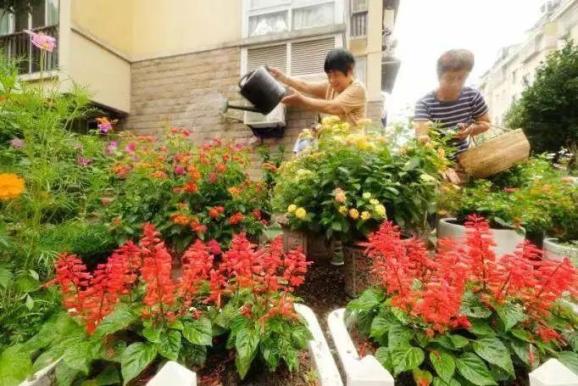
"Shared Garden" in Chenpodu Community of Shounan Street.
cause
Solve the problem of sanitary dead angle
"Dirty land" turned into "small garden"
The tall bougainvillea falls with rose petals, clusters of blue hydrangeas bloom in the sun, and the arched doors decorated with vines and roses seem to enter the fairy tale world … Chenpodu Community in Shounan Street is a resettlement community, which has been built for 18 years. When you walk into the community, you can see a well-dressed "shared garden" from time to time, which is a scene step by step.
No one can imagine that these "shared gardens" used to be public green spaces with piles of sundries.
Three years ago, this public green space was a dirty and messy sanitary corner, but it was always difficult to be cleaned up repeatedly. In 2018, Chenpodu Community began to build a "shared garden", and Yang Weirong, a resident who loves flowers and plants, took the lead in "land reclamation" and moved the flowers and plants in his home downstairs. Soon, more and more residents joined the "gardener" team. Today, there are nine "shared gardens" in Chenpodu Community, with a total area of over 1,400 square meters.
Zhousu Yunting Community in the eastern suburb street is also a resettlement community, and there are uncivilized situations such as destroying green vegetables and putting idle flower pots in the corridor to affect the fire escape. With the care of more than 10 enthusiastic residents, these places have become "shared bonsai gardens". Resident Wo Aimei moved her family’s flowers, such as Chlorophytum, Eupatorium odoratum and Capsicum annuum, to the "shared garden". Driven by her, residents Lu Qiuxian sent Dan Dinghong and Yan Chenbo cactus, and more and more residents put their idle green plants in the "shared garden".
Not long ago, the 42nd "shared garden" was planted in Chunxiao Community in the south of Panhuo Street. The lawn soil in this old community is exposed because of neglect of maintenance and illegal parking of vehicles. After renovation, arches, rockeries, bonsai, vibrant bushes and colorful Gesanghua have become the punching points for residents.
"Shared Gardens" are blooming everywhere in Yinzhou. Combined with the history and culture of streets and lanes and the architectural style of residential quarters, all street communities have promoted micro-transformation of barren and dirty public spaces with micro-creativity, and built a "shared garden" with blooming flowers, pleasant scenery and rich culture, and completed "beautiful transformation".
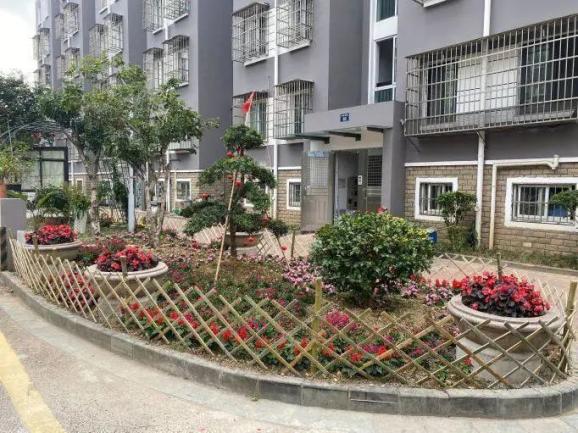
"Shared Garden" in Bicheng Community of Fuming Street
maintain
Public space co-construction and sharing
Onlookers become "enthusiastic people"
"I didn’t expect that after the’ micro-transformation’, the enthusiasm of residents to participate in the management of the’ shared garden’ was higher." Sun Danling, secretary of the Party Committee of Bicheng Community in Fuming Street, said that from the residents of the community, a group of residents who love to grow flowers and plants were selected as volunteers. Through cooperation with universities, the usual sanitary corners were lit and beautified with green ideas, and the residents themselves were mobilized as supervisors.
"The plants that the big guys put together, after being designed by a professional team, have a three-dimensional sense and layering." Ye Mingzhong, a resident of Bishui Hecheng Community, is the representative of the "Green Housekeeper" volunteer team in the community. He drives other volunteers to take care of the flowers and trees at No.4 point in front of the house, watering, loosening the soil and pulling up the grass … Looking at the "shared garden" in front of him, it is getting more and more beautiful, and everyone enjoys it.
In order to maintain the "shared garden" at home, resident volunteers have also made a "maintenance convention": they can only rest and chat next to the "shared garden" and are not allowed to play chess and cards; Chatting time should not exceed 8:30 pm, so as not to disturb the people; Everyone must take turns to take care of the flowers every day … Next, the function of "shared garden" in Bishui and the urban community will be continuously expanded. For example, a pavilion is being built next to the point along the river in the west. After completion, residents can read books, newspapers and do manual work in the pavilion to shelter from the wind and rain.
In the Ivy Community of Minglou Street, the planting tools, garden seeds, fertilizers, etc. needed to transform the "shared garden" are raised by the residents in the corridor. After raising enough funds, the residents worked together to eradicate weeds, pave garden paths with stones, plant flowers and plants, and put up protective fences … In order to better maintain the "shared garden", the community discussed and elected the location of the "shared garden" and made a weekly duty watch to be responsible for daily watering and fertilization.
Siming Middle School, a member of the Party Building Alliance of Taikoo Cheng Community Joint Education in Dongliu Street, built and maintained a "shared garden", and the "semi-wild" balcony was transformed into a "happy farm". The fruits such as figs, lemon trees and blueberry fruit trees were shared with residents, making the surrounding residents feel different urban pastoral life.
The implementation of sharing and claiming is another attempt by the community to promote residents’ autonomy and self-management. In Yinzhou, the "shared garden" not only brought together residents, but also mobilized the enthusiastic participation of community talents, cultural and creative teams, teachers and students of colleges and universities, and units under their jurisdiction to realize co-construction and sharing in a wider scope.
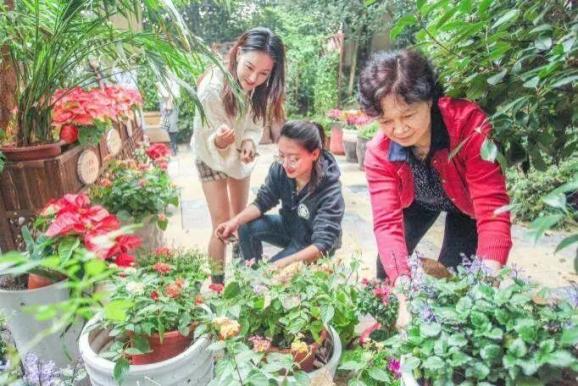
"Shared Garden" has become a practice place for neighborhood communication.
explore
Grassroots governance stimulates vitality.
"Small Garden" Derives "Big Function"
"There are many gardens and flowers in the community. How about making use of them and doing dried flowers and creativity?" "No, no, I can’t bear to pick flowers." "This is the Garden Chamber, and another garden can also be a garden study and a garden chess hall, and nine gardens are connected in a line!" ….. So many gardens, how to explore the functions other than enhancing the value of the community? A residents’ Council opened in the "Shared Garden" in Chenpodu Community.
Zhang Huiling, secretary of the General Party Branch of Chenpodu Community, said that since the "Shared Garden" was set with stone benches and chairs and became a "Garden Chamber" for residents to have a rest and enjoy the cool, it has become a platform for community residents to discuss and discuss, which has mobilized the enthusiasm of residents to participate in community governance.
It is understood that garbage sorting, exterior wall painting, setting up fitness spots, etc. in the community, all kinds of more than 20 major and minor matters related to residents’ lives are discussed in the "shared garden".
The "shared garden" is set on the lawn next to 10 buildings, which is a special area opened up by the community. Zhou Lei, secretary of the Party branch on the bank of the Yangjiang River in Xiaying Street, said: "The community residents are gathered together through flowers and plants. On the one hand, we exchange experiences in flower cultivation and promote neighborhood feelings; Secondly, we can listen to residents’ opinions and demands on community governance, resolve the ideological’ bumps’ in the hearts of the masses, improve community services, and let residents fully participate in community construction. "
The "shared garden" in the Golden Waterfront Community of Zhonggongmiao Street has become a venue for practical classes. Sun Lijun, a community expert, took the community owners to a gardening class in the "Shared Garden". Under the guidance of Sun Lijun, the skillful housewives use the height difference of different plants to create a three-dimensional sense of height.
At present, the "shared garden" has expanded its position function, resulting in "practice class", "chat round table" and "garden conference hall", which has become a platform for residents in the community to discuss and discuss. Some problems in the community have been solved in the beautiful scenery of the garden, which has injected new kinetic energy into grassroots social governance.
Original title: "Creating a model city of national civilization |" Dirty land "becomes a" small garden ",and these shared gardens in Yinzhou derive" great functions ""