"It’s not enough to explore the vast China with a lifetime" (the tutor talked to me about China)
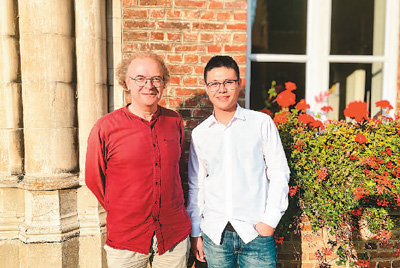
Luo Yuansheng (right) took a group photo with his tutor.
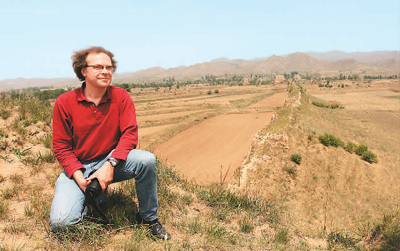
The author’s tutor took a photo during his inspection in China. The pictures in this article are all provided by the author.
Luo Yuansheng is studying in Belgium. His tutor, Thomas Goldman, is an architectural historian. He has visited China many times, visited a lot of China buildings and is very interested in China culture.
Not long ago, Goldman Sachs told Luo Yuansheng about his fate with China, and let’s listen to their discussion on China’s urban development, architecture and culture.
My tutor is a "China hand"
Two years ago, I was lucky enough to get the support of the National Scholarship Committee, and went to Leuven University in Belgium to carry out the doctoral research on the cultural exchange between Chinese and Western architecture, under the guidance of Professor Thomas Coomans, an architectural historian. Tutor, an elegant Chinese name, was given to him many years ago by a sinologist at the University of Leuven in Belgium and a professor at Southeast University.
Before that, I had the privilege of listening to a lecture by Mr. Goldman Sachs on the exchange of Chinese and western architecture in Tongji University. At that time, I was deeply impressed by his profound knowledge and enthusiasm for China culture. I believe I can learn a lot from studying with him.
Later, when I was studying in chalmers university of technology, Sweden, I came across a large number of China architectural image files recorded by modern westerners, but they were not fully studied. I realized that this is expected to be a valuable cross-cultural research topic, so I planned to write a brief doctoral research plan and ask Mr. Goldman Sachs for advice. The teacher attached great importance to my research plan, so we had further contact. After studying with him for a doctorate, he carefully guided me to continue the research.
In the two years since I entered the doctoral program, Mr. Goldman not only gave me a lot of support in my research and life, but also often showed a strong interest in China culture. I gradually realized that Mr. Goldman was a real "China hand": he trained more than a dozen doctors from China, visited China for many times, and still teaches part-time in Peking University. In addition, he visited a large number of ancient buildings in China and established a profound friendship with scholars in the field of archaeology, culture and architecture in China. He has published a large number of works on architectural exchanges between China and the West at home and abroad, and made important contributions to cultural exchanges and mutual learning between China and the West.
Just in May this year, Mr. Goldman once again set foot on a trip to China. Shortly after my return to Belgium, my teacher met me and chatted about his fate with China and his understanding of cross-cultural studies.
Teacher Goldman excitedly listed to me the places he had visited in China: Beijing, Shanghai, Tianjin, Heilongjiang, Inner Mongolia, Shandong … … He couldn’t help but sigh with emotion: "It is not enough to explore the vast China in a lifetime."
He likes Beijing very much, and recalls: "Many years ago, I lived in an alley near the Forbidden City, and there were several shoe repair stalls beside the alley. My neighbors gave me this ‘ Foreigner ’ Very friendly. " This year, Mr. Goldman revisited his old place. He said with emotion: "The area around the Forbidden City is more urbanized than before, but the street stalls are still well preserved."
He marveled at the rapid development of Shanghai. He said: "Twelve years ago, Sheshan area was still a large area of farmland, and now there are rows of high-rise buildings." Mr. Goldman loves the night in Shanghai: the lights are on, and Chinese and western buildings with different styles stand on both sides of the Bund, which are eye-catching under the reflection of colored lights. He said, "It’s a beautiful scene of prosperity full of vitality."
In China this year, Mr. Goldman reunited with his friends from China after a long separation, and was invited to share his recent research in many colleges and universities. He is good at communicating with friends in China. He believes that language is a communication tool, and obscure words should be used as little as possible in academic communication. As a scholar of architectural history, he is good at communicating with friends in China by drawing: "I always take a sketch book with me when I go to China. I have drawn countless buildings in China. In rural China, drawing can eliminate the communication barriers brought by dialects. " He mentioned that when villagers saw his sketches, they would always guide him to interesting places and invite him to have tea with them. This is because the villagers feel the strong interest of Mr. Goldman Sachs in them.
In addition, he also recalled the experience of publishing books with professors in Peking University many years ago. He said: "At that time, I knew nothing about Chinese publishing, but our books needed bilingual typesetting, so the workload was very heavy. Mutual trust, respect and learning contributed to this pleasant cooperation, and also prompted me to decide to continue to bring more foreign students to Peking University for exchanges. "
Cross-cultural communication in the eyes of instructors
Mr. Goldman grew up in a cross-cultural family. His father worked in Congo, his brother lived in Indonesia, his son-in-law came from Brazil, and his granddaughter had multiple nationalities. He is full of curiosity about new things. He loves China cuisine, and thinks that many neglected ingredients in Europe have been used to the extreme by Chinese, making all kinds of delicious food. He also said: "In China, dining is a social activity full of ritual. Chinese pays attention to ritual when drinking tea, and the tea set is exquisite and systematic."
Mr. Goldman’s interest in the communication between Chinese and Western architecture began when he discovered a group of buildings almost the same as those in the west in the northern countryside of China. He is eager to understand the origin. After in-depth study, he found: "The two are not exactly the same, especially in terms of building materials, uses and orientations."
He believes that this is influenced by the local environment and lifestyle of residents, and has nothing to do with architectural style. He said: "The craftsmen in China incorporated some western elements in the construction and created uniqueness according to specific needs, which reflected the great wisdom of the craftsmen in China. Therefore, to do a good job of mutual learning between Chinese and Western civilizations, we must first study the ancient civilization of China, including the geographical environment, history and culture of China. "
Mr. Goldman has more than ten years of cross-cultural teaching experience. During his time with China students, he found: "China students are good at thinking and like to ask me questions during recess, which is often a well-thought-out question."
In the class of Mr. Goldman Sachs, I found that when he introduced China architecture, he not only relied on slides, but also showed the bricks he had painstakingly brought back from China.
He explained: "In this way, we can not only intuitively understand the differences between Chinese and western brick-making techniques, but also understand that not all bricks are red, and many bricks are cyan or gray." I immediately asked Miss Gao why she wanted to introduce so many traditional buildings in China to western students. He replied: "I want students to understand that the concept of protection based on western masonry is not applicable in all cases, and forcibly applying it to wooden buildings in East Asia will cause many problems." He further concluded: "The same is true for cross-cultural communication. We need to embrace diverse values and learn tolerance and understanding."
(The author is a doctoral student in the Department of Architecture, University of Leuven, Belgium)