What about the golden monkeys in Yunnan, Guizhou and Sichuan?
Original Ran Hao, Huang Zijian shell nature.
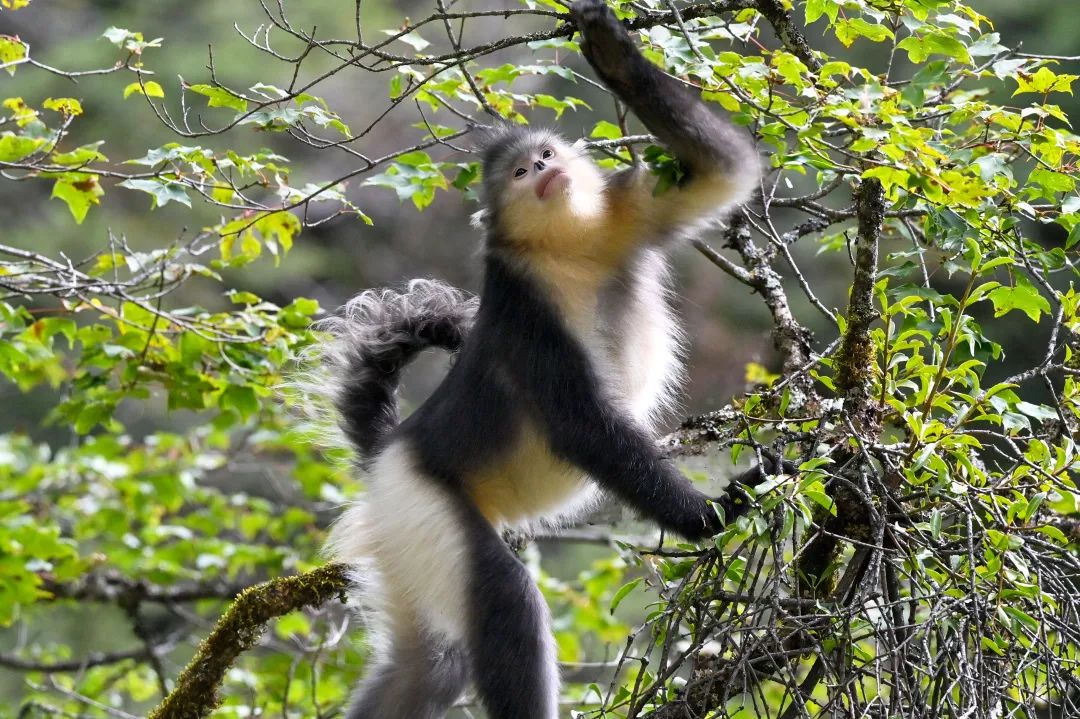
The golden monkey is a very famous rare primate, and everyone may have heard its name more or less. However, in fact, golden monkeys have not only one species, but five species. Moreover, not all golden monkeys are covered with golden hair. Among them, Rhinopithecus brelichi, known as the "only child in the world", is a mixture of black and gold. Its head and deltoid hair tend to be golden, while the hair on its limbs is completely black and looks very special.

Rhinopithecus brelichi, the gray snub-nosed monkey | Photo: Li Guiyun
Recently, the Primate Genome Project initiated by Chinese scientists published a special research issue in the famous academic journal Science, which not only explained the origin of the black and gold mixed hair of Guizhou golden monkey, but also found ancient parents for Guizhou golden monkey, and the story inside was quite tortuous.
A monkey with a nostril facing upwards.
Golden monkeys belong to langurs, whose heads often look a little sharp in appearance. They take plants as their main food, and chewing leaves is a daily thing. The Primate Genome Project reconstructed the spreading route of langurs in Asia for 8 million years, and denied the hypothesis that they entered East Asia through the north, but thought that they arrived in East Asia through the southern foothills of the Himalayas and south to Southeast Asia. And about 7.5 million years ago, the strange-nosed monkey, where the golden monkey belongs, began to rise and became a major force among Asian langurs.
Why is it called a strange nose monkey? Because if you count the golden snub-nosed monkeys, the four genera of the strange-nosed monkeys together can’t make up a Zhou Zheng’s nose-yes, so can the golden snub-nosed monkeys. Their official name is Rhinopithecus, which means that their nostrils are facing the sky.
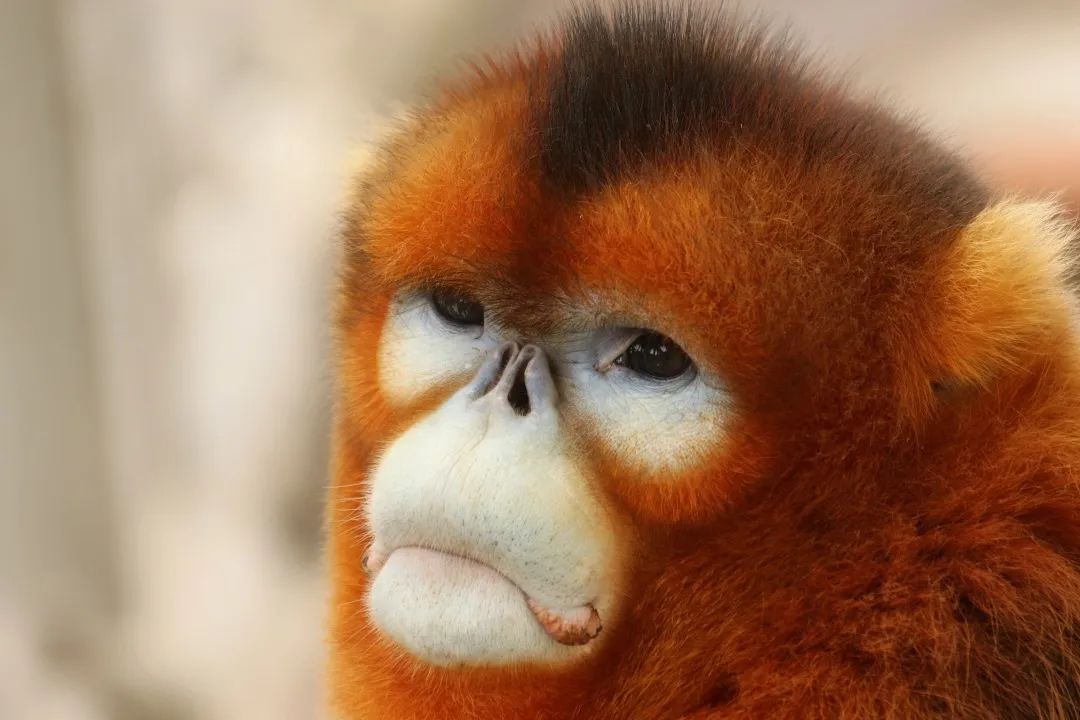
The famous Sichuan golden monkey also has its nostrils facing the sky. Do you think it will get into the water in rainy days? | Figure worm creativity
Noses facing the sky do not represent the arrogance of the golden monkey, they are just the nasal bone. In the long-term evolution process, the nasal bone completely degenerates and disappears, resulting in a shorter nose, so it seems that the nostrils are a little upturned, which is conducive to increasing ventilation in plateau areas. In fact, the golden monkey is relatively mild among monkeys, belonging to the kind of good temper, and can form large groups. The primate genome project also explains the emergence of this characteristic from the molecular mechanism, which may be related to adapting to the cold climate.
Let’s talk about the color of the golden monkey. In fact, only R. roxellana in Sichuan, Shaanxi, Gansu and Shennongjia, Hubei, China, is really covered with golden hair. It is the first species found in the golden monkey, and it is also the reason why the golden monkey got its name. While Yunnan golden monkey (R. bieti), Nujiang golden monkey (R. strykeri) and Vietnamese golden monkey (R. avunculus) are called golden monkeys, but their hair is mainly black or mixed with black and white.
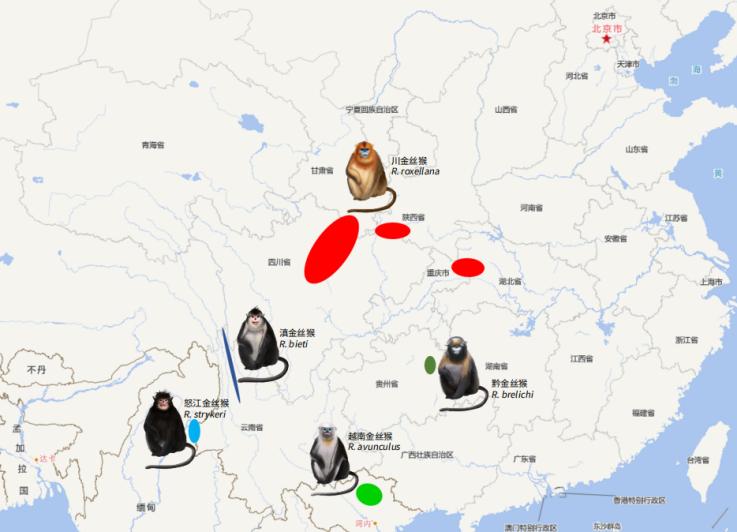
Distribution areas of five species of golden monkeys | Photo courtesy of Yu Li’s research group, etc.
The Guizhou golden monkey is the third case, which has both golden hair and black hair. Moreover, Guizhou golden monkeys are particularly rare. There are currently more than 2,400 giant pandas, while there are only about 850 golden monkeys in Guizhou. Its distribution area is also particularly limited, only distributed in Fanjing Mountain area in northern Guizhou, and it is called "the only child in the world".
This makes people wonder how the unique hair of Guizhou golden monkey came from. How did this golden monkey with such a limited distribution originate? What is the genetic relationship with several other golden monkeys? How did this species form?
Classical seed formation and hybrid seed formation
In the classical evolutionary theory, an ancestor population was separated into several independent populations that could not communicate with each other due to migration and environmental changes, and each of them accumulated different mutations and became different. Then, even when they meet again, they can’t produce fertile offspring, which is the reproductive isolation caused by geographical isolation. Based on this, ernst meier thinks that the key to the definition of a species is to see whether a population can be isolated from other populations, that is, the generation of reproductive isolation marks the formation of new species. This argument has been regarded as a standard by countless people, and has been written into high school textbooks, which is well known to people.
It is precisely because of this that the evolution process is often described as an evolutionary tree-a tree structure in which the common ancestor population keeps branching out over time. This tree structure, in which each branch does not cross each other, shows us that the ancestors of each living species at any historical stage came from the same population. Today, the tree of species evolution is one of the most commonly used things for biologists to discuss species evolution.
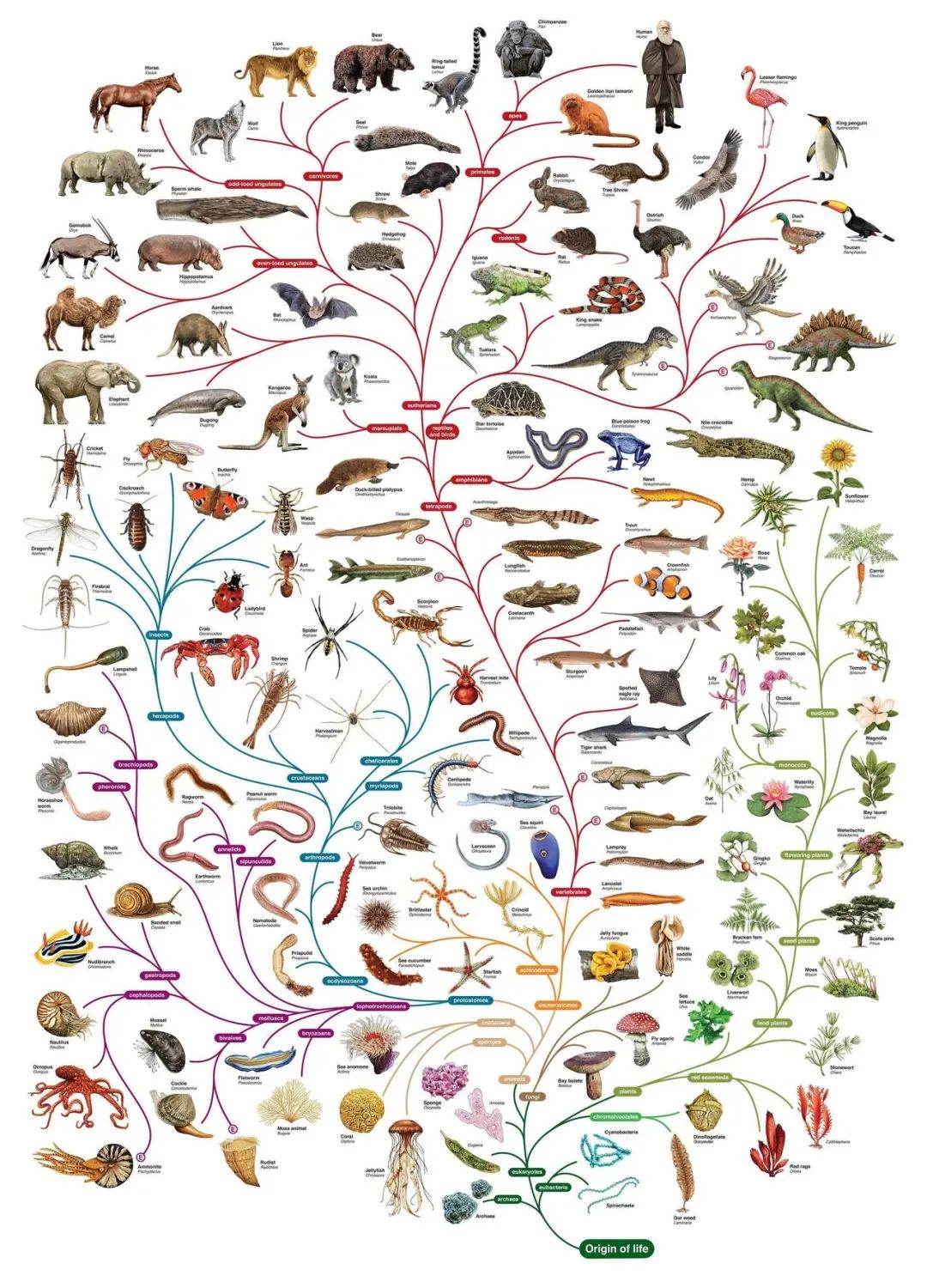
Did you find a human | |openlearn
Later, people gradually realized that cross-species hybridization is also one of the mechanisms for the formation of new species. Especially in the process of plant evolution, hybrid speciation is considered as an important mode of speciation, which can usually be divided into three forms: polyploid speciation, homoploid hybrid speciation and introgressive hybrid speciation.
Polyploidization is to keep the chromosomes of two parent species at the same time, so as to double the genetic material, and quickly produce reproductive isolation with the parents to form new species. For example, the tetraploid Primula kewensis comes from the hybridization of two diploid species Primula verticillata and Primula floribunda. However, this method can only occur in plants and other highly compatible genetic systems, and it is almost impossible to happen in animals. Autoploid hybridization and introgression will not change the multiple of genetic material, but will only show a "mosaic/patch" genetic composition due to recombination. In the process of introgression, the offspring will cross with at least one parent species for many times before forming a new species.

Hybrid Primula Qiuyuan | |penprimulas
Botanists are very familiar with hybridization. However, when it comes to animal evolution, zoologists have different views. In the past, they generally believed that animals were unlikely to cross into species.
However, with the analysis of genome data of more and more species, zoologists have found that the reproductive isolation between species in many groups is not as strong as expected, and it is very likely that hybridization can occur. At present, there are many known groups such as butterflies, wolves, baboons, birds and bears, which have experienced rapid adaptation to radiation, that is, a large number of new species broke out in a short period of time.
In this evolutionary process, some species come from interspecific hybridization of two or more different species, rather than always being descendants of a single ancestor species. At this time, the simple tree structure can no longer accurately describe the evolution of species.
So, what kind of formation process has the golden monkey species experienced? How did the Guizhou golden monkey form?
An unexpected and reasonable conclusion
Guizhou golden monkey is probably an example of hybridization in nature.
As one of the projects of Primate Genome Project, the team of researcher Yu Li from Yunnan University, together with several research teams, assembled the high-quality reference genome sequence of Yunnan golden monkey, and conducted population genetics analysis on the whole genome data of 106 samples from all five species of golden monkey.
The results show that the genome of Guizhou golden monkey has mixed genetic components from Sichuan golden monkey population and Yunnan golden monkey/Nujiang golden monkey ancestor population, which are equivalent to the parents of Guizhou golden monkey. But this is different from ordinary mating. Generally speaking, the genetic material ratio of offspring from parents is close to 1:1, but a larger proportion of the genome of Guizhou golden monkey comes from the parents of Sichuan golden monkey. That is to say, from the perspective of genome, Guizhou golden monkey is more like Sichuan golden monkey. This is probably the reason why it is widely used as a sister species of Sichuan golden monkey in previous studies.
According to the genome, the researchers made a backward inference and carried out an ancestor simulation. The results show that the evolution model of Guizhou golden monkey is likely to be like this:
About 1.87 million years ago, there was a hybridization event between the ancestors of Sichuan golden monkey and Yunnan golden monkey/Nujiang golden monkey, resulting in the original Guizhou golden monkey population.
In later years, Guizhou golden monkey, which originated from hybridization, screened the genetic components of different parents in order to restore or maintain the stability of genomic biological function.
In addition, there were two hybridization events between the common ancestors of Guizhou golden monkey, Sichuan golden monkey and Yunnan golden monkey/Nujiang golden monkey.
Therefore, this story sounds a bit chaotic, but it explains why the genetic material from different parent species in the genome of Guizhou golden monkey is not balanced.
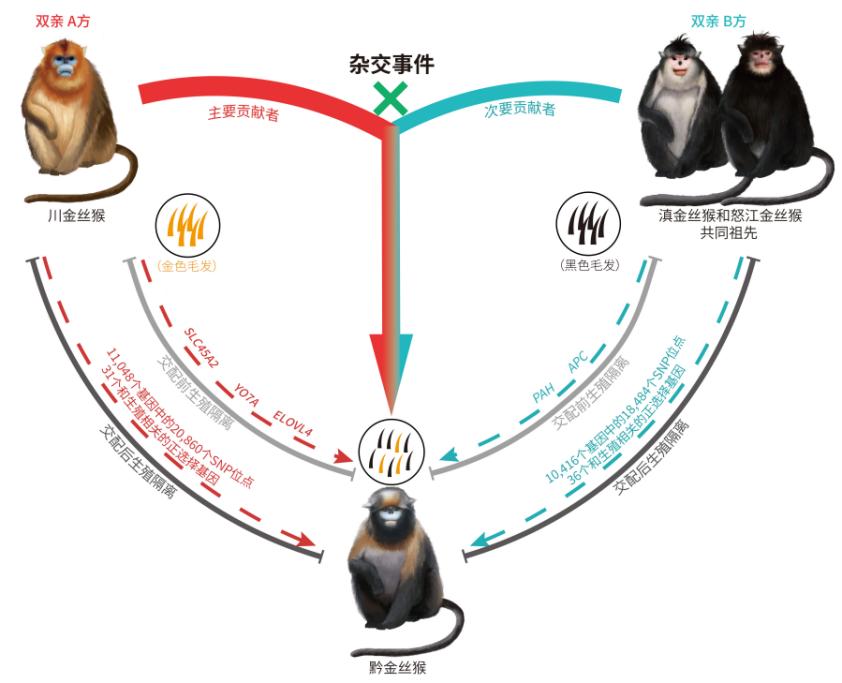
Evolution of Guizhou golden monkey | Photo courtesy of Yu Li’s research group
The next step is the hair color of Guizhou golden monkey. The researchers found genes related to the formation of special mosaic coat color of Guizhou golden monkey. It was found that the hair color of golden monkey was determined by the ratio of melanin to eumelanin. When the proportion of brown melanin is high, there will be golden hair. When the proportion of melanin is low, there will be black hair. The proportion of brown melanin in the head and deltoid muscle of Guizhou golden monkey is high, showing golden color; The proportion of brown melanin in limbs is low, showing black. Yu Li and others discovered five genes related to melanin synthesis in Guizhou golden monkey, and they came from different sources-SLC45A2, MYO7A and ELOVL4 genes came from Sichuan golden monkey, while PAH and APC genes came from the common ancestor of Yunnan golden monkey and Nujiang golden monkey. It is precisely because of the recombination of melanin synthesis genes from different sources in the genome of Guizhou golden monkey that the unique mosaic coat color of Guizhou golden monkey is caused.
Then how did the Guizhou golden monkey form reproductive isolation from the other two species and eventually become an independent species?
Maybe it was related to the color of hair at first. Sexual selection may be the explanation-the hair of the golden monkey is different from that of the other two species. A great possibility is that for Sichuan golden monkeys, individuals with golden hair are often more popular with the opposite sex; For Yunnan golden monkey or Nujiang golden monkey, individuals with black hair often have more advantages in mate selection; For Guizhou golden monkeys, they prefer individuals with golden heads and black limbs. As a result, pre-mating isolation is formed.
To put it bluntly, they don’t like each other, and they are not each other’s "dishes". The picture shows the idea of Yunnan golden monkey | worm.
In addition to the isolation before mating, the isolation after mating may also promote the evolutionary independence of Guizhou golden monkey and its two parents. For example, in terms of genes related to reproductive traits, there are 31 genes inherited from Sichuan golden monkey and 36 genes inherited from another parent in the genome of Guizhou golden monkey. As a result, based on these two functional gene sets related to reproduction, Guizhou golden monkey may establish cross-mating isolation with two parents, and eventually form an independent species.
The evolution of Guizhou golden monkey proves that mammals can form new species through hybridization. The success of this research also shows that the primate genome project initiated by Chinese scientists has unlimited potential. There are more than 500 primate species in the world. Studying them can help us to know more about the origin, evolution, physiological characteristics, genetic variation map and pathogenic gene variation of human beings.
references
[1]Bi XP, Zhou L, Zhang JJ, …, Zhang GJ. 2023. Lineage-specific accelerated sequences underlying primate evolution. Science Advances 9. Doi: 10.1126/sciadv.adc9507.
[2]Fiziev PP, Mcrae J, Ulirsch JC, …, Farh K K-H. 2023. Rare penetrant mutations confer severe risk of common diseases. Science 380. Doi: 10.1126/science.abo1131.
[3]Gao H, Hamp T, Ede J, …, Farh K K-H. 2023. The landscape of tolerated genetic variation in humans and primates. Science 380. Doi: 10.1126/science.abn8197.
[4]Kuderna LFK, Gao H, Janiak MC, …, Bonet TM. 2023. A global catalog of whole-genome diversity from 233 primate species. Science 380, 906-913. Doi: 10.1126/science.abn7829.
[5]Qi XG, Wu JW, Zhao L, …, Li BG. 2003. Adaptations to a cold climate promoted social evolution in Asian colobine primates. Science 380.Doi: 10.1126/science.abl8621.
[6]Rivas-gonzález I, Rousselle M, Li F,…, Zhang GJ. Pervasive incomplete lineage sorting illuminates speciation and selection in primates. Science 380.DOI: 10.1126/science.abn4409.
[7]Shao Y, Zhou L, Li F,…, Wu DD. 2023. Phylogenomic analyses provide insights into primate evolution, Science 380, 913-924.Doi: 10.1126/science.abn6919.
[8]Sørensen EF, Harris RA, Zhang LY, …, Rogers J. 2023. Genome-wide coancestry reveals details of ancient and recent male-driven reticulation in baboons. Science 380. Doi: 10.1126/science.abn8153.
[9]Wu H, Wang Z, Zhang Y, …, Yu L. 2023. Hybrid origin of a primate, the gray snub-nosed monkey. Science 380. Doi: 10.1126/science.abl4997.
[10]Zhang BL, Chen W, Wang ZF, …, Wu DD. 2023. Comparative genomics reveals the hybrid origin of a macaque group. Science Advances 9. Doi: 10.1126/sciadv.add3580.
[11]Zhou Y, Zhan XY, Jin JZ, …, Zhang GJ. 2023. Eighty million years of rapid evolution of the primate Y chromosome. Nature Ecology & Evolution. Doi: 10.1038/s41559-022-01974-x.
Authors: Ran Hao and Huang Zijian.
Editor: You Zhiyu, Sister Hei jio
Thanks to Mr. Yu Li and Mr. Wu Hong for their comments.
Cover Image Source: Picture Worm Creativity
Original title: "Do something" gross "! What happened to the golden monkeys in Yunnan, Guizhou and Sichuan? 》
Read the original text