Good things in Hunan, cattle seats in Xinshaoping: a rare food in Meishan area
Editor’s note:Since ancient times, there are not only outstanding people, but also rich things.
Hunan cuisine, one of the eight major cuisines, Hunan embroidery, one of the four famous embroideries, black tea, black tea and green tea, white wine with strong sauce flavor … There are too many good things in Hunan!
From now on, Red Net News will launch a series of reports "Good Things in Huxiang". Please follow the reporter’s brush strokes to explore the good things that are "famous in the world" or "raised in boudoir" and the stories behind these good things.
Red Net News reporter Chen Gang correspondent Yang Nengguang Xin Shao reports.
Ping town, Daxin Town, Tanxi Town, Longxipu Town and Yingguang Township in Xinshao County are adjacent to Lianyuan, Lengshuijiang, Xinhua and Longhui in the core circle of Meishan culture, respectively. They are famous for their classic Meishan food culture, with far-reaching influence.
Ping town is just a little-known town in Xinshao County, and Niuxi on Pingshang is one of the most distinctive Hunan dishes in Xinshao. As the signature dish of Ping Shang Niu Xi, the main ingredient of tripe, tripe must be qianzi meat from fresh cattle tripe. In addition, Sanhe soup, another representative dish of Ping Shang Niu Xi, must be composed of the blood of buffalo (because of its freshness), the belly of female buffalo (because of its thickness) and the tenderloin of male ox (because of its tenderness, but there are other sayings), and then it is authentic to take clear well water as the source of soup.
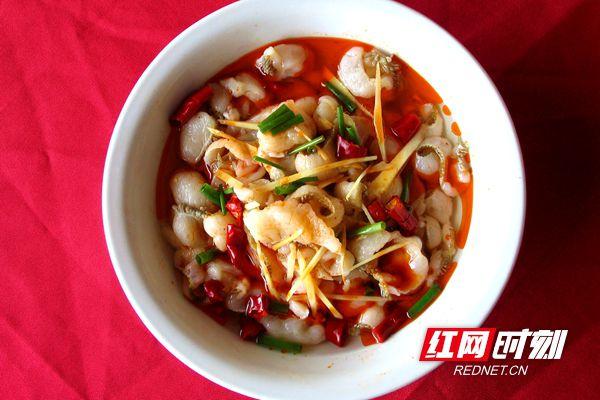
A mouth-watering stir-fried tripe.
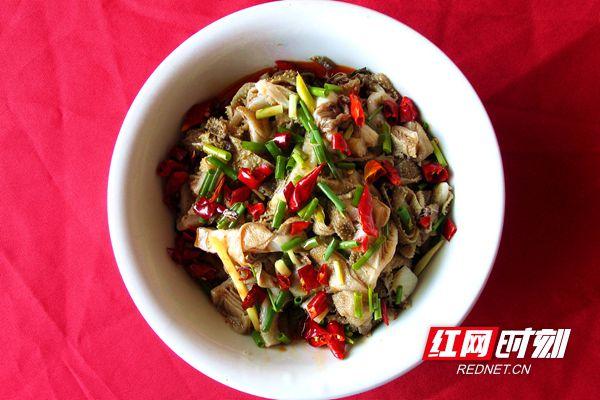
Stir-fried beef tripe.
"The master is in the folk", this sentence is more appropriate for the folk chefs on the lawn. Here, just like ordinary village women and farmers, they can cook attractive tripe.
However, in the cooking process, they never perfunctory, but strictly pay attention to knife work, ingredients and temperature. As a knife worker, after wringing out the water in the tripe, it should be cut into thin strips with uniform thickness and length (taking 1 inch long and 5 minutes wide as the most standard), so as to ensure uniform heating and frying at the same time; In terms of heat, the so-called "less heat is not ripe, more heat is not crisp". When cooking, you must use strong fire. After the oil in the pot rolls like boiling water, you will pour the tripe into the oil with a swish, stir-fry it for a few times, and the control of heat depends entirely on the chef’s mind and hands, which cannot be achieved overnight. As far as ingredients are concerned, stir-fried tripe is indispensable to chili (spicy dried red pepper is preferred), shredded ginger, garlic, orange peel, etc., and local mountain pepper oil is indispensable. When tripe is about to be cooked, stir-fry the dried red pepper, shredded ginger, garlic and orange peel for several times, and finally add salt and mountain pepper oil, and cook the tripe as soon as it is cooked. The tripe fried in this way is not fishy and chewy, tender, sweet, spicy and crisp, which is memorable. Of course, cooking is a matter of time, and tasting is also a matter of time. Stir-fried tripe on the flat must be eaten immediately after it is served, otherwise it will harden when it gets cold, and the flavor will be greatly reduced, thus wasting the chef’s good skills, and some people who don’t understand the mystery also blame the chef for "not getting started", which is really a great injustice.
Meishan area is mostly cold and humid, and people will catch a cold if they don’t pay attention. Meishan cuisine, with its characteristics of sour and spicy, chowder, secret pot brewing and raw food, has a good therapeutic effect. For example, beef is low in fat and high in calories, which is suitable for women, children and young people. Especially, the important condiments of beef, such as pepper, mountain pepper, prickly ash and garlic ginger, have the effects of pungent smell, dispelling cold and removing dampness. In the era of lack of medical care and medicine, local people regard stir-fried beef and tripe as good medicines to cure colds. According to legend, when Shi Dakai, the general of the Taiping Heavenly Kingdom, led his troops through ping town, many soldiers fell ill and caught a cold in the army because of the cold. After an old woman discovered it, she fried tripe with the local unique mountain pepper for the soldiers to eat. After eating it, the soldiers immediately sweated and soon recovered, and the tripe on the flat came into being. For a long time, generations of well-known or unknown chefs, relying on continuous exploration and extensive absorption, have continued to carry forward this dish and become a signature dish for local guests. In 2005, Su Zhaohua, a ping town folk chef, won the gold medal in the first Hunan Cuisine Cooking Competition with his "stir-fried tripe", which made Pingshang tripe famous. Nowadays, there are signature restaurants on Pingshang tripe all over the country. According to statistics, there are no fewer than 500 large and small restaurants named Pingshang tripe king in China, and there are more than 10,000 Hunan dishes with Pingshang tripe king in the menu. Especially in Xinshao, its birthplace, in any large-scale restaurant, you can eat Pingshang tripe, which can be described as "tripe is fresh and spicy, and a dish is fragrant all over the world." In addition, Zeng Guofan once put Xinhua (Pingshang was a new one)Three-in-one soup is regarded as a military dish, which is popular all over the country, and it is also because it can relieve epidemics.
Exploring the origin of Pingshang Niuxi, a unique food culture, is due to the abundant sources of ingredients in the region. There are abundant forest and grass resources in Pingshan mountain area, which is suitable for raising yellow cattle with relatively small size and strong climbing ability and suitable for terrace farming. Second, visceral ingredients such as tripe, blood, tongue, intestines, etc., although delicious, are just the food of the lower Liba people who are not allowed to sit on the table in other places, so they disdain fine cooking and will not be used to entertain guests. Eating it occasionally is just adding some oil, salt, ginger and onion for a change. Pingshang, on the other hand, is located in a remote place, and its economy is relatively backward, so it has no greater consumption power in terms of precious ingredients, sauces, vinegar and other condiments. Therefore, the local people follow the cooking principle of taking local materials and making the ingredients that other regions despise not only edible, but also delicious. Exchange and learn from each other, learn from each other’s strengths, and let the food culture evolve from the way of survival to the way of life, which will make foreigners sit up and take notice. At the same time, turning the "marginalized" food that outsiders and rich people disdain into local food with Shan Ye flavor directly reflects the virtue of advocating frugality and the extraordinary creativity of turning decay into magic.
Reporting/feedback